Mastering Your 2026 Adventures with a Canva Travel Planner
As a designer and strategist, I often see clients struggle with the gap between a brilliant idea and a tangible, organized execution. This is especially true in travel planning. The excitement of booking a flight is quickly buried under a pile of scattered confirmation emails, vague itinerary notes, and last-minute packing panic. The solution isn't just better planning; it's better design assets. A well-structured system transforms chaos into clarity, and that's the core philosophy behind the 2026 Travel Planner Canva Template.
Visual Style and Core Personality
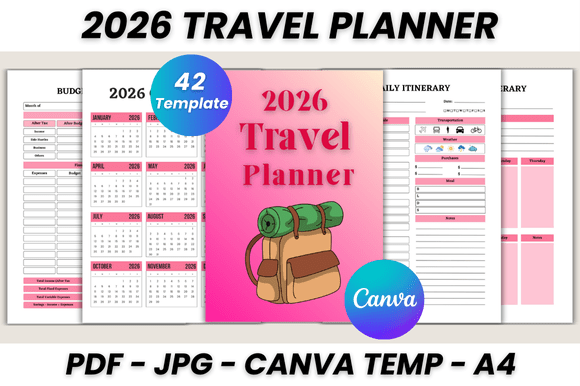
This isn't just a collection of pages; it's a cohesive brand identity for your travel year. The visual personality is clean, modern, and incredibly functional. Think of it as a premium font for your plans—every element is intentionally placed for maximum readability and ease of use. The style leans into a minimalist aesthetic with ample white space, which is crucial for a document that will hold dense information like itineraries and budgets. The color palette is likely neutral and calming, allowing your own photos and notes to stand out. The use of icons and structured grids provides a clear visual hierarchy, guiding your eye from the most critical information (like your flight time) to supporting details (like your hotel's check-in policy).
The overall appeal is one of organized elegance. It feels professional and trustworthy, which is exactly the perception you want when managing a significant investment like a vacation. This template functions as a creative font for your plans, giving them a polished, intentional look that a simple notebook or spreadsheet can't match.
Practical Applications Beyond the Trip
The true strength of this Canva template is its versatility. While its primary use is for personal vacation planning, its structure is invaluable for a range of professional and creative projects.
For marketers and content creators, it's a perfect framework for planning a content trip or a brand retreat. Use the Research Index and Brainstorm pages to outline campaign goals, and the Daily Itinerary to schedule shoots and meetings. The Budget Planner and Expense Tracker become essential for reporting.
Small business owners and entrepreneurs can adapt it for planning trade shows, client visits, or team offsites. The Trip Planner and Road Trip Overview pages are ideal for mapping out a multi-city sales tour. The Hotel Information and Accommodation sheets keep all vendor details in one place, projecting professionalism.
For designers and publishers, the template itself is a lesson in editorial design. Analyze how it uses grids, typographic pairing (likely a sans serif font for headings and a clean serif or sans for body text), and white space. You can use the Notes and My Notes pages for client feedback or project brainstorming. The Shopping List can be repurposed as a design asset list for a project.
Maximizing the 42-Page System
With 42 printable pages, the system is comprehensive. To get the most out of it, approach it with a strategist's mindset. Don't just fill it out; use it to think.
- Start with the Macro: Use the 2026 Calendar and Monthly Planner to block out travel dates and major events first. This gives you a high-level view of your year.
- Layer in the Details: For each trip, move to the Trip Planner and Travel Itinerary pages. This is where you convert ideas into an actionable sequence. The Weekly Itinerary is particularly useful for longer trips.
- Manage the Logistics: The Packing List, Checklist, and Shopping List are your operational tools. Customize them for each destination. The Expense Tracker is non-negotiable for staying on budget.
- Capture the Experience: The Travel Journal, Notes In Review, and Organized Chaos pages are your creative outlet. They allow you to move beyond logistics and document the emotional and narrative arc of your journey. This is where you build lasting memories.
The Editable Files are the key to making this system your own. You can change fonts, sizes, colors, layout style, and even add your own logo. This level of customization ensures the planner aligns with your personal or brand aesthetic, enhancing brand consistency and recognition if you're using it professionally.
Strategic Evaluation and Pairing
When integrating this template into your workflow, consider its role in your broader ecosystem of design assets. It's a commercial font of sorts—a specialized tool designed for a specific job. Its effectiveness lies in its readability and logical flow. The modern typography and clean layout reduce cognitive load, making planning less stressful.
Evaluate its fit by asking: Does this system scale to my needs? For a solo traveler, it's perfect. For a family, you might duplicate pages for each member. For a business, you can adapt the Research Sheet for competitive analysis at your destination.
While the template comes with a suggested style, you can test font pairings within Canva. Perhaps swap the heading display font for a bold serif font for a more classic feel, or a script font for personal journaling pages. The goal is to maintain the system's inherent visual hierarchy while infusing your personality.
Ultimately, the 2026 Travel Planner Canva Template is more than a printable PDF. It's a framework for intentionality. It applies the principles of good graphic design and brand strategy to the art of travel, ensuring that your adventures in 2026 are not only well-planned but also beautifully documented.