Elevate Client Care with a Professional Tattoo Aftercare Card
As a tattoo artist, your work doesn't end when the needle stops. The long-term vibrancy and health of your art depend heavily on the client's aftercare routine. Handing over a slip of paper with hastily written instructions is a missed opportunity. It can feel unprofessional and may lead to clients forgetting crucial steps. This is where a dedicated, well-designed aftercare card becomes an extension of your service, reinforcing your commitment to quality from start to finish.
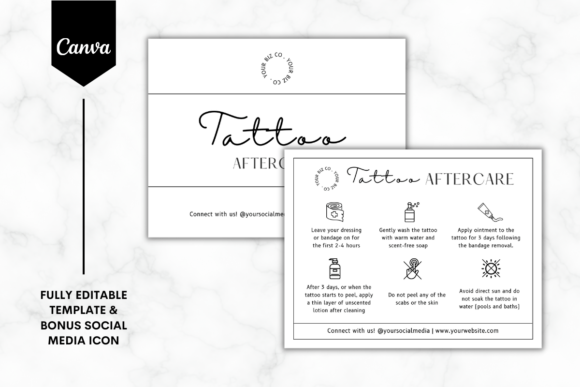
The Tattoo Aftercare Card Canva Template 2 is a practical design asset created to solve this exact problem. It’s more than just a list of do's and don'ts; it’s a branded touchpoint that blends essential information with clear, modern typography. The template's visual personality is clean, organized, and authoritative without being intimidating. It uses a thoughtful mix of font styles—a clear sans-serif for body text ensures high readability, while a tasteful display or script font for headings adds a touch of style that can be adapted to your studio's aesthetic. The overall appeal is one of professionalism and care, assuring your client that they are in good hands.
Practical Applications for a Branded Aftercare Solution
The true value of a tool like the Tattoo Aftercare Card Canva Template 2 lies in its versatility. Its primary function is, of course, as a physical takeaway for your clients. Printed on a sturdy cardstock, it becomes a durable keepsake that clients can pin to their fridge or tuck into their wallet. The 5.5"x4.25" size is ideal—large enough to hold all necessary information but small enough to be convenient.
Beyond the physical card, the template's design principles are easily adapted for digital use. You can export it as a high-resolution image or PDF to include in post-appointment emails. This serves as a perfect digital reminder and is especially useful for clients who might misplace the physical card. The clean layout also translates well to social media graphics. Imagine sharing a "Aftercare Tip of the Week" on Instagram using a consistent visual style derived from your aftercare card. This builds brand recognition and positions you as an expert. For studios with a merchandise or online store, the design elements could even inspire the branding for aftercare products like specialized lotions or soaps, creating a cohesive brand identity.
Design Influence: Readability, Hierarchy, and Professionalism
Effective editorial design is about guiding the reader's eye, and the Tattoo Aftercare Card Canva Template 2 excels in this. The visual hierarchy is carefully constructed. The most critical information, like "Keep it Clean" or "Avoid Sun Exposure," likely uses a bolder weight or a distinct display font to grab immediate attention. Supporting details are set in a legible sans-serif font, ensuring the instructions are easy to follow step-by-step.
This deliberate use of modern typography directly impacts client engagement. A well-structured card with clear headings, subheadings, and bullet points makes the information feel manageable rather than overwhelming. This enhances readability, especially for someone anxious about caring for a new tattoo. From a branding perspective, a professionally designed card elevates your studio's perception. It signals attention to detail and a high standard of care, which builds client trust and encourages repeat business. Consistency is key; using this template across all client interactions reinforces your brand's look and feel, making your studio more memorable.
Customizing Your Template in Canva
The power of this template is its adaptability within Canva. You are not locked into a single style. Here’s how to approach personalization:
- Evaluate Your Brand Fit: Before you start editing, consider your studio's vibe. Is it minimalist and modern, or bold and traditional? The template's elements are a starting point. You can change the colors to match your logo and website palette. Swap the placeholder fonts for ones from your own brand kit or explore Canva's library. A script font might suit a studio with a fine-line, illustrative style, while a geometric sans-serif font could better match a shop specializing in blackwork.
- Test Font Pairings: If you decide to change the fonts, pay attention to pairing. A common and effective approach is to combine a stylish heading font with a highly readable body font. Ensure the chosen typeface for body text is clear at smaller sizes, as this is where the core instructions will live. Avoid overly decorative or complex handwritten fonts for large blocks of text.
- Content is King: The template provides a framework, but the content should be yours. Edit the instructions to reflect your specific aftercare recommendations. You might have a preferred healing method or a particular product you suggest. This personalization makes the advice more credible and tailored to the work you do.
Remember, this is a digital product designed exclusively for Canva. The provided PDF includes a direct link to your copy of the template and straightforward instructions. To get started, you only need a free Canva account. While the Canva app on a phone works, a computer is highly recommended for the detailed customization process. By investing a small amount of time to personalize this design asset, you create a powerful tool that protects your art, impresses your clients, and strengthens your brand long after they leave your chair.